
-
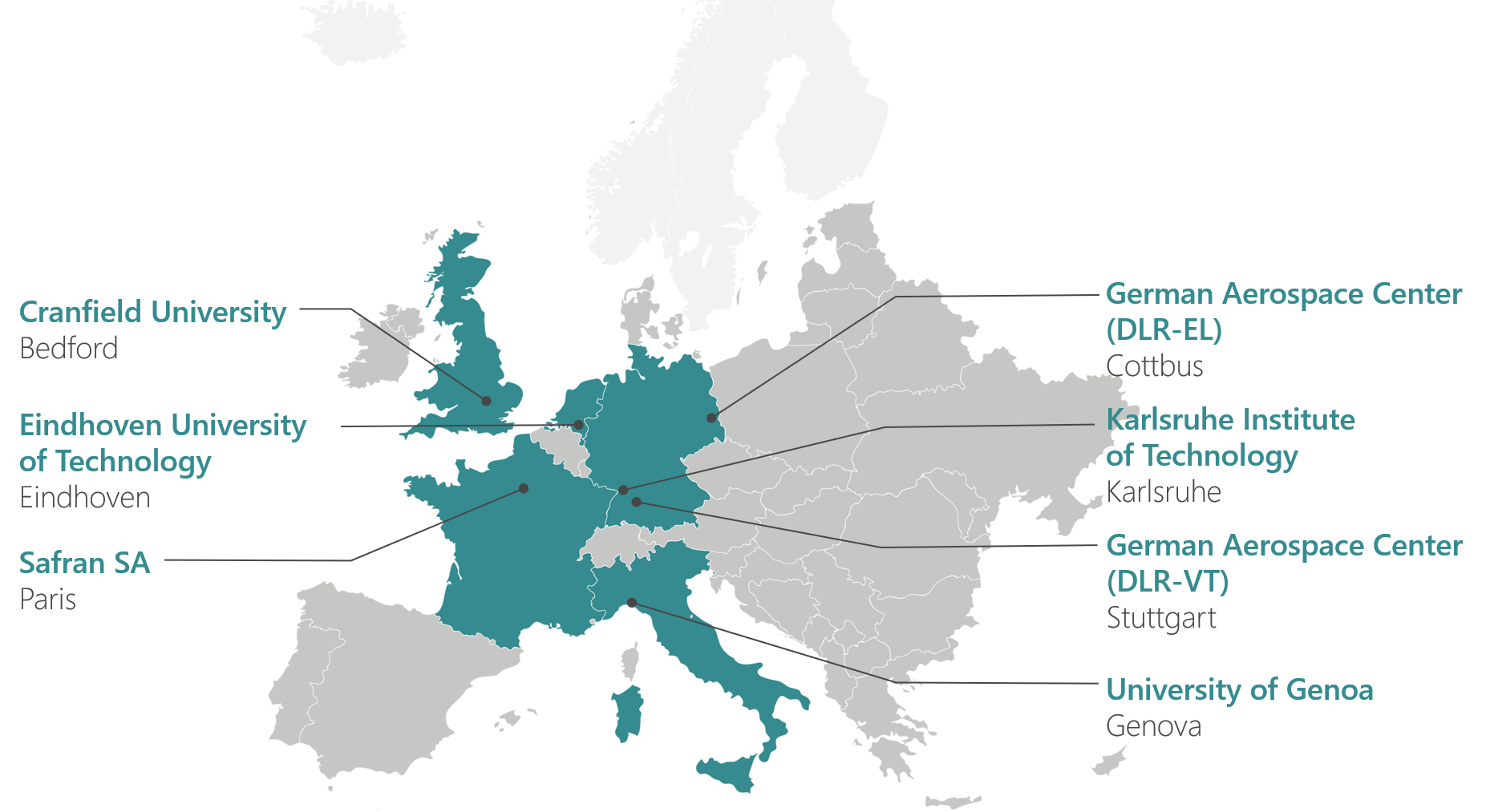
DLR Institute of Electrified Aero Engines, Cottbus
Our responsibilities include coordinating the project and external communication to ensure effective collaboration among all partners and transparent progress sharing. A key focus of our work is developing the integration concept for the SOFC system, with particular attention to safety aspects such as fire protection and prevention, redundancy, and zoning. The main subsystems concerned are the air supply and hydrogen/steam supply between the SOFC and the gas turbine. The goal is to ensure seamless and efficient integration and to optimize the overall system towards the key performance indicators of the project (soon to be published – stay tuned) together with all our project partners and their expertise. Furthermore, we are responsible for the detailed design of critical components necessary for the cycle integration of the SOFC stacks with the gas turbine. Another important aspect of our role is defining the balance-of-plant controller for the SOFC system, which is crucial for reliable operation. To validate and optimize this, we are conducting real-time modeling of the SOFC system and electrical architecture for proof-of-concept experiments on HiL simulation rigs. Finally, we are implementing the developed controllers into the test rig at DLR-VT to evaluate their performance and reliability under realistic conditions. We are proud to contribute our expertise and innovative approaches to this groundbreaking project and look forward to the challenges and successes ahead!
-
DLR Institute of Combustion Technology, Stuttgart
Description of institution
DLR-VT has a wide expertise in combustor development and testing, setup and characterization of gas turbine rigs, optical combustion and flow diagnostics, CFD and kinetic modelling as well as SAF prescreening and property analysis. The institute runs several gas turbine rigs for studying and demonstrating innovative cycles in aeronautics and stationary energy supply. These rigs are also widely utilized for inhouse development and testing of jet-stabilized combustion systems in the real test environment. The combustion systems are developed for different power classes, ranging from small micro gas turbines (15 – 1000 kW) up to heavy duty gas turbines. The institute has wide testing capabilities of atmospheric and pressurized burner rigs up to 40 bar for a wide variety of gaseous and liquid fuels. In combination with highly sophisticated optical and laser-based diagnostics both global and detailed combustion characteristics and exhaust gas emissions can be analyzed supporting the combustor design process. Thereby, the full range from fundamental combustion understanding over gas turbine cycle optimization to testing of industrial components is accessible.Contributions to the project
In the FlyECO project the institute coordinates WP4. In this work package the experimental proof-of-concepts are addressed. The first task is the evaluation of the effects of steam injection to a generic gas turbine combustor utilizing pure hydrogen in the pressurized burner rig up to roughly 1 MW. These tests will analyze the effects of different steam ratios and inlet temperatures as well as variable fuel air mixing qualities on the flame shape and position and on the associated exhaust gas emissions. These tests will help to understand the impact of the fuel cell exhaust gases on the subsequent gas turbine combustion. The second task focusses on the cyber-physical validation of the overall system setup and energy flows. For this purpose, the institute’s hybrid electric propulsion test rig (HeBo) is used. This rig is based on a M250 turbo shaft gas turbine (300 kW) in combination with an integrated motor-generator-unit, a fuel cell emulator and an additional load machine on the gas turbine’s shaft. This setup provides the possibility to emulate the electric characteristics of a SOFC fuel cell boosting the gas turbine shaft. Additionally, steam injection into the gas turbine’s combustion chamber is investigated emulating the thermodynamic coupling of the fuel cell exhaust gas with the gas turbine. With the help of real-time SOFC models provided by DLR-EL and a global system controller provided by TUE the coupling of gas turbine and SOFC fuel cell will be investigated in this hardware-in-the-loop setup. Finally, the institute will provide reactor network simulations of gas turbine combustion chambers to analyze the effect of the different boundary conditions (pressure, temperature, steam, load point) on NOx emissions utilizing hydrogen during the flight mission. These results will contribute to the simulations of the overall 1MW+ IPPS in order to evaluate the system performance. -
Cranfield University, Bedford
Description of institution
Cranfield is an internationally leading, research-intensive University with a strong track record in Net Zero and Sustainable Aviation. The activities of the Hybrid Electric Propulsion Group at Cranfield focus on the development, integration and operation of novel and sustainable power and propulsion technologies that encompass electric and hybrid systems along with the development of integrated solutions that explore the synergies of gas turbines closely coupled with batteries, fuel cells, electric and thermal management systems.Contributions to the project
Design and performance analysis of hybrid Gas Turbines for the IPPS Development of a novel model predictive controller for hybrid Gas Turbines Design and control of electrical system and components Development and integration of technology roadmaps for highly integrated Gas Turbine and Solid Oxide Fuel Cell Power and Propulsion Systems -
Karlsruhe Institute of Technology – Institute for Applied Materials – Electrochemical Technologies (IAM-ET), Karlsruhe
Description of institution
The Institute for Applied Materials - Electrochemical Technologies (IAM-ET) at KIT focuses on electrochemical energy storage and conversion technologies: batteries, fuel cells, electrolysis, and electrosynthesis. The FCE group is working on electrochemical characterization and modeling of fuel cells and electrolyzers since 1996. Testing of high (SOFC/SOEC) and low temperature (PEMFC/PEMEC) cells including impedance spectroscopy and DRT analysis, accompanied by material and microstructural analysis (tomography), are applied for performance and durability evaluation as well as model development and parameterization.Contributions to the project
At KIT, IAM-ET a design-flexible cell/repeat unit model is developed in order to conduct performance simulations of actual and future cell/stack designs in selected IPPS operating states. For model development, parameterization and validation, SOFC testing including detailed EIS and DRT analysis is performed. The model will be applied in simulation studies to evaluate the feasibility of advanced SOFC designs for airborne applications. Next to gravimetric and volumetric power density of future SOFC modules, internal states will be considered to estimate degradation and failure risks. -
SAFRAN SA, Paris
Description of institution
Safran is an international high-technology group, operating in the aviation (propulsion, equipment, and interiors), defense and space markets. Its core purpose is to contribute to a safer, more sustainable world, where air transport is more environmentally friendly, comfortable, and accessible. Safran has a global presence, with 92,000 employees and sales of 23.2 billion euros in 2023, and holds, alone or in partnership, world, or regional leadership positions in its core markets. Safran undertakes research and development programs to maintain the environmental priorities of its R&T and innovation roadmap.Contributions to the project
Within the FlyECO project, SAFRAN is at the forefront of developing a 1MW+ Integrated Power Plant System (IPPS) simulation environment. The exploration of system topologies will yield optimal Solid Oxide Fuel Cell-Gas Turbine (SOFC-GT) architectures for the IPPS. This framework will facilitate a comprehensive evaluation of the coupled system's operational strategies, with the environment, system requirements, and Key Performance Indicators (KPIs) for the 1MW+ IPPS being derived from top-level aircraft requirements (TLARs). -
Eindhoven University of Technology (TUE) – Control Systems Technology section – MOVEMENT Research Group, Eindhoven
Description of institution
The mission of the Control Systems Technology (CST) section is to develop new methods and tools in the areas of systems theory, control engineering and mechatronics. Our research focuses on understanding the fundamental system properties that determine the performance of mechanical engineering systems and exploiting this knowledge to design and operate high-tech systems of the future. Within this section, the mission of the MOVEMENT (Modeling and Optimization for Vehicle Electrification, Materials, Epidemics and Novel Topics) Research Group is to develop optimization models and methods for systems and control, with as strong focus on sustainable transportation systems. This encompasses everything from individual vehicles and their propulsion systems to multi-level mobility networks.Contributions to the project
Our responsibilities include coordinating Workpackage 3 on control concepts for energy distribution and power allocation and devising control strategies to coordinate the operation of the subsystems in an optimal fashion. A key focus of our work is identifying dynamic and quasi-static models of the individual components and their interconnection, and cost functions and operational constraints that are computationally tractable and can be integrated within optimization problem formulations aimed at computing optimal operational trajectories for a given flight mission. Such trajectories can be used as a reference for real-time controllers and as a benchmark to assess their performance. Moreover, we are responsible for the development of online implementable high-level energy management strategies to coordinate the operation of the gas turbine, the SOFC and the rest of the plant, selecting the optimal mechanical and electrical power-splits to be achieved via local low-level controllers, whilst accounting for the very strong thermo-electro-mechanical interconnections present. Finally, we are supporting the implementation of our developed controllers into the test rig at the Institute for Combustion Technologies at DLR to evaluate their performance and reliability under realistic conditions. -
University of Genoa, Genova
Description of institution
UNIGE participates to this project with the DIME department that hosts (since 2004) the Fuel Cell Systems University Technology Centre of Rolls-Royce and the Fincantieri joint laboratory “HI-SEA”. The activities planned for this project will be performed by the Thermochemical Power Group (TPG) that is composed of mechanical, energy and chemical engineers. The TPG has experience on advanced energy systems including fuel cells, hybrid systems, gas turbines, optimization, alternative fuels, hydrogen technologies, etc.Contributions to the project
UNIGE will put at the project disposal different component models for the hybrid system simulations (SOFC, heat exchangers, recirculations, ejectors, blowers, compressor, turbine, combustor, valves, etc.). The UNIGE core contribution regards the system modelling and simulations with a special focus on the BoP. In details, UNIGE will be the WP2 leader and will manage T2.1 and 2.4. Moreover, UNIGE will have a minor role in the other WPs with special attention on the general requirements and system design, control system and dissemination.